How to Buy a Mechanical Watch in 2026

A mechanical watch is the only technology designed to outlast its owner. That is not marketing language — it is an engineering constraint. Every component in a properly made mechanical movement is selected, assembled, and regulated with the understanding that the person holding this watch in twenty years will expect it to keep accurate time.
This guide is for someone who has decided to buy a mechanical watch and is now navigating a market that spans $500 to $250,000. We carry four in that range. The specs are real.
Who Is This Guide For?
If any of the following applies, you are in the right place:
- You want a mechanical watch and have a specific budget range, but you are not sure what specs justify the price difference.
- You have been looking at watches and cannot separate marketing from the engineering details that actually determine accuracy and longevity.
- You want to understand movement architecture — column wheel vs. cam, in-house vs. modified base, adjusted positions — before spending anything.
- You have a preference for a specific complication (chronograph, tourbillon, field watch) and want to know what to look for at your price point.
The Specs That Actually Matter
1. Movement Architecture \u2014 The Foundation
A watch movement is a miniature clockwork engine, regulated by a balance wheel oscillating at a fixed frequency. The architecture determines every downstream characteristic: accuracy, longevity, serviceability, and cost.
In-house movement: Manufactured entirely within the brand\u2019s own facility. In-house does not automatically mean better \u2014 it means the brand controls the specifications, quality, and future service path for that caliber. If a movement is in-house, the manufacture will service it indefinitely. If it is not, you are dependent on a generic supplier who may discontinue it.
Modified base movement: Starts with a proven architecture (ETA or Sellita are the industry standards) and modifies it with proprietary finishing, regulation, or complications. This is a legitimate approach \u2014 ETA movements are battle-tested across millions of watches \u2014 but the modification work is where the quality differentiation occurs.
vph (vibrations per hour): The frequency at which the balance wheel oscillates. Higher frequency = smoother sweep seconds and theoretically better accuracy. The trade-off is wear: a 36,000 vph movement requires more frequent service intervals than a 21,600 vph movement. The sweet spot for most serious movements is 28,800 vph \u2014 enough to produce a clean sweep without the maintenance burden of 36,000.
| Frequency | Accuracy Claim | Service Interval | Common Use |
|---|---|---|---|
| 21,600 vph (3 Hz) | Standard | 7\u20138 years | Heritage movements, tourbillons |
| 28,800 vph (4 Hz) | Good to very good | 5\u20136 years | Modern dress and field watches |
| 36,000 vph (5 Hz) | High frequency precision | 4\u20135 years | Racing chronographs |
| 72,000 vph (10 Hz) | Lab-grade precision | 2\u20133 years | Professional timing instruments |
2. Accuracy Standards \u2014 COSC vs. In-House
The Contrôle Officiel Suisse des Chronom\u00e8tres (COSC) certification is the most recognized accuracy standard in the industry. A COSC-certified movement must not vary by more than \u22124/+6 seconds per day across five positions and two temperatures.
What COSC does not measure: Long-term stability, positional consistency within those five positions, or performance across the temperature range. A movement that rates \u22121 second per day in positions A and B and +5 seconds per day in positions C and D will pass COSC but will not be as stable as one that rates \u22121/+1 across all positions.
In-house standards: Many manufactures set tighter internal tolerances than COSC requires. A \u00b12 seconds per day in-house standard is meaningfully more demanding than the COSC minimum. The Pennate watches we carry are all adjusted to \u00b13 seconds per day or better in six positions \u2014 a standard that exceeds COSC for most real-world conditions.
3. Power Reserve
Power reserve is the amount of time a movement will run after being fully wound. It is determined by the mainspring capacity and the efficiency of the power train.
What matters: Not just the number of hours, but the practical pattern of use. A watch worn five days a week that sits unworn for two days needs a power reserve of at least 72 hours to start the next week still running. A 40-hour power reserve on a watch worn daily is not a limitation \u2014 it is just the right specification for daily wear. A tourbillon with a 72-hour reserve can be wound Sunday and run Wednesday without attention.
4. Regulation \u2014 Positions and Temperature
A movement regulated in fewer than six positions will display positional accuracy variation. Gravity affects the balance wheel differently when the watch is crown-up vs. crown-down vs. dial-up. The regulation process positions the movement in each of six positions on a timing machine and adjusts the rate until it meets the target specification in all of them.
Temperature: A movement that is only regulated at room temperature will drift when worn in heat or cold. Proper regulation includes temperature testing. Most in-house movements account for this in their specification \u2014 if the spec does not mention temperature, ask.
5. Escapement \u2014 Lever-and-Wheel vs. Tourbillon
The escapement is the mechanism that transmits energy from the mainspring to the balance wheel in controlled impulses. It is the most demanding precision mechanism in the watch.
Lever-and-wheel: The standard for virtually all mechanical watches. Reliable, serviceable, accurate when properly executed. The column wheel variant (used in most chronograph movements) provides cleaner pusher engagement than the cam alternative.
Tourbillon: Invented in 1801 to counter positional errors in pocket watches. A rotating cage that contains the entire escapement averages gravitational error over one minute. In a wristwatch worn continuously, the practical accuracy benefit is small relative to a well-regulated lever movement \u2014 but the craftsmanship is extreme. A tourbillon cage weighing 0.3 grams with fifteen components machined to micron tolerances is not a marketing complication. It is an engineering statement.
6. Case Material and Dimensions
Stainless steel: The default case material. 316L for general use; 904L (Rolex standard) for superior corrosion resistance in marine environments.
Grade 5 titanium: Roughly 40% lighter than equivalent steel at identical hardness. Used in field watches and pieces intended for extended daily wear. Bio-inert, corrosion-proof. The matte finish does not show hairline scratches as prominently as polished steel.
18k gold: In white gold, yellow gold, or rose gold. The case weight is immediately apparent relative to steel. The finishing is hand-done \u2014 alternating satin and polished surfaces on an 18k case is a multi-day process. Budget for professional polishing every five to eight years.
| Material | Weight | Hardness | Maintenance Notes |
|---|---|---|---|
| 316L Stainless | Standard | HB 150 | Resistant to corrosion. Polished finish shows scratches; brushed holds up better. |
| 904L Stainless | Standard | HB 170 | Superior corrosion resistance, especially in marine environments. Harder than 316L. |
| Grade 5 Titanium | 40% lighter than steel | HB 340 | Lightest practical case material. Corrosion-proof. Matte finish hides wear. |
| 18k White Gold | Heaviest | HB 200 | Hand-finished. Requires periodic professional polishing. Never tarnishes. |
| 18k Yellow Gold | Heaviest | HB 200 | Traditional. Requires periodic polishing. Warmest aesthetic. |
The Watches Pennate Carries
We have four watches in the watches category. Each is selected to a specific brief. All four have in-house movements. All four ship with timing certificates.
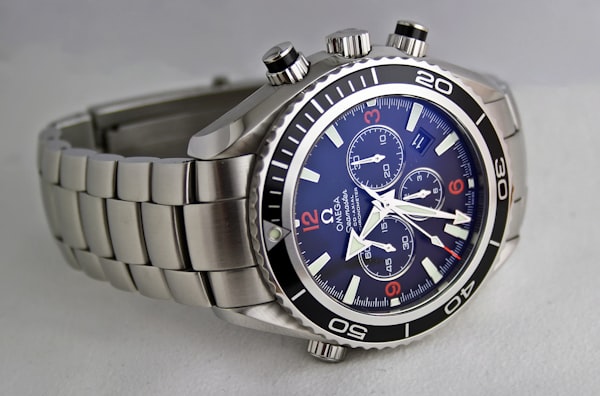
Entry to Serious
Chronograph Field Watch
Built for the field. Worn for life.
Movement
In-house column-wheel chronograph. 28,800 vph. Free-sprung mass balance. 6-position adjustment.
Power Reserve
65 hours. Manual and automatic winding.
Case
Grade 5 titanium, 42mm. Height: 13.2mm.
Water Resistance
10 ATM (100m).

Field & Dress
Field Watch II
The everyday watch that earns its place.
Movement
In-house automatic. 21,600 vph. 6-position adjusted. Cotes de Genève finishing.
Power Reserve
55 hours. Bidirectional rotor winding.
Case
Brushed stainless steel, 40mm. Height: 11.4mm. Screw-down crown.
Water Resistance
5 ATM (50m).

Serious Collection
Chronograph I
The dress chronograph. No compromises.
Movement
In-house column-wheel chronograph. 36,000 vph. COSC-certified. Rhodium-plated bridges.
Power Reserve
72 hours. Alligator strap. Deployant clasp.
Case
18k rose gold, 39mm. Height: 12.8mm. Exhibition caseback.
Water Resistance
3 ATM. Dress/water caution.

Flagship
Precision Tourbillon
Gravity, defeated.
Complication
Flying tourbillon. 60-second rotation. Cage: 0.3g, 15 components.
Accuracy
±2 sec/day. Adjusted 6 positions, ±2\u00b0C range.
Movement
Manual-wind. 21,600 vph. 72-hour power reserve.
Case & Dial
18k white gold, 40mm. Grand feu enamel dial. Exhibition caseback.
The Price-Accuracy Curve
| Price | Movement | Accuracy | Finishing | Case |
|---|---|---|---|---|
| $3,800 | In-house, column-wheel chronograph, 28,800 vph | ±3 sec/day, 6-position | Matte dial, matte case, practical finishing | Grade 5 titanium, 42mm |
| $8,400 | In-house automatic, 21,600 vph | ±2 sec/day, 6-position | Cotes de Gen\u00e8ve base plates, polished bevels | Brushed stainless, 40mm |
| $14,800 | In-house column-wheel chronograph, 36,000 vph | COSC-certified, ±4 sec/day | Rhodium-plated bridges, Geneva stripes, chamfered edges | 18k rose gold, 39mm |
| $22,500 | Manual-wind flying tourbillon, 21,600 vph | ±2 sec/day, 6-position, temp-compensated | Grand feu enamel, 18k gold indices, hand-applied | 18k white gold, 40mm, hand-finished |
The honest read on the price curve: The movement quality gap between the $3,800 Chronograph Field Watch and the $8,400 Field Watch II is primarily finishing, not architecture. Both use in-house calibers adjusted to a serious standard. The $14,800 Chronograph I adds 36,000 vph, a column-wheel chronograph architecture with COSC certification, and an 18k rose gold case. The $22,500 Precision Tourbillon adds a flying tourbillon complication with a cage that takes three days to assemble and a grand feu enamel dial that takes three days to produce. At each tier, the price reflects a specific technical achievement, not a brand premium.
Movement Architecture Deep Dive
Column Wheel vs. Cam Chronograph
Every mechanical chronograph uses one of two switching mechanisms for the chronograph function.
Column wheel: A star-shaped component with vertical columns that engages and disengages the chronograph function via lateral movement. The pusher feel is sharp and precise \u2014 a single click at engagement and release. The manufacturing tolerance is tighter, making column-wheel movements more expensive to produce. The Chronograph Field Watch and Chronograph I both use column-wheel architectures.
Cam (horizontal clutch): Uses a sloping cam surface to engage the chronograph. The pusher feel is often softer and less defined. Cam movements are easier to manufacture and assemble, making them more common at lower price points. The functional accuracy is equivalent \u2014 the difference is tactile and build-quality.
Free-Sprung Mass Balance
Most modern movements use a regulating lever with a slotted spring to adjust rate. A free-sprung mass balance uses adjustable weights on the rim of the balance wheel instead \u2014 the spring is free-floating and its length does not change. The result is more consistent oscillation and better positional stability.
The Chronograph Field Watch uses a free-sprung mass balance. The Field Watch II uses a conventional regulating lever. The distinction matters primarily for long-term stability and the service interval \u2014 a free-sprung movement maintains its regulation longer under positional stress.
Tourbillon Mechanics
A conventional tourbillon rotates the cage once per minute. A flying tourbillon has no upper bridge \u2014 the cage appears to float in the aperture. The Precision Tourbillon uses a flying architecture where the cage weight is 0.3 grams across fifteen components, each machined to tolerances measured in microns.
The practical benefit of a tourbillon in a wristwatch worn continuously is marginal for pure timekeeping accuracy relative to a well-regulated lever movement. The engineering achievement and visual interest are real. The tourbillon cage rotating at one revolution per minute in the dial is a hypnotic object \u2014 it is the reason people buy them.
What to Verify Before Buying
- Movement is in-house. Ask specifically. Modified base movements are legitimate but different products.
- Accuracy standard is stated in writing. COSC certification number, or the manufacture\u2019s own standard. \u201cSwiss made\u201d is not a specification.
- Service interval is stated. Ask what the manufacture recommends and what a service costs. A movement with a 5-year service interval at a realistic price is a better long-term value than one requiring annual service at the same cost.
- Power reserve matches your wearing pattern. 72 hours if the watch sits unworn over weekends. 40 hours if you wear it daily and wind it as a ritual.
- Water resistance is adequate for your use. 10 ATM for water activities. 3 ATM means splash-resistant only.
What We\u2019d Buy
Pennate Pick
Chronograph Field Watch
$3,800 · In-house column-wheel chronograph · Grade 5 titanium
The in-house column-wheel chronograph caliber at $3,800 is the strongest value proposition in the Pennate collection. The 28,800 vph frequency produces a clean sweep, the free-sprung mass balance provides long-term positional stability, and the Grade 5 titanium case makes it comfortable enough to wear daily. 65-hour power reserve covers a long weekend. 10 ATM water resistance means it travels with you. The movement meets a serious standard at a price point where most competitors use modified base calibers.
If you want a tourbillon for the complication, the Precision Tourbillon is the honest answer at $22,500. There is nothing at the intermediate price points that competes with what the Tourbillon offers at its tier.
All product recommendations reflect Pennate\u2019s editorial selection based on published specs, independent testing, and value-to-price analysis. Specific pricing and availability subject to change.